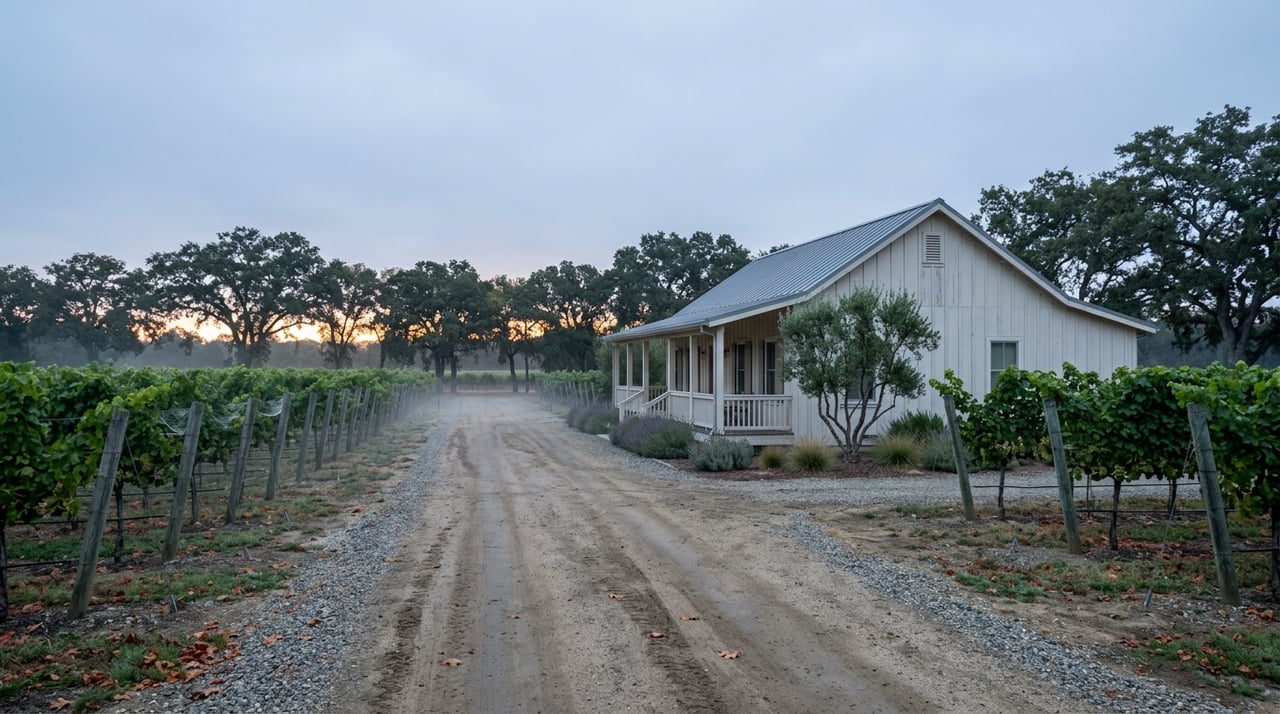
In April 2026, Chanel's St. Supéry Estate Vineyards & Winery bought Rudd Estate, the Oakville winery founded by the late Leslie Rudd, for more than $39 million. The number traveled fast through wine country group chats and made its way into every conversation that starts with "so what's land actually worth out there now."
Here's the problem with doing that math. The $39 million did not buy 65 acres of dirt. It bought 65 acres, only 47 of them planted to vines, plus a working winery, the Crossroads wine brand, and existing inventory. Divide the headline number by the acreage and you get a figure that describes none of the things that were actually sold. You're averaging a winery, a label, a cellar full of wine, and a piece of land into one meaningless per-acre estimate.
If you're circling Oakville as a buyer right now, this matters more than it would almost anywhere else. Oakville doesn't give you enough real transactions to sanity-check a bad number against a good one. You have to know what you're actually pricing before you can price it.
What $39 Million Actually Bought
St. Supéry, which Chanel has owned since 2015, told Wine Spectator it had been hunting for the right Oakville vineyard since that acquisition. What it landed on was Rudd's eastern Oakville property off the Silverado Trail, a site the winery's CEO told the Napa Valley Register she had "long admired." Leslie and Susan Rudd bought the land in 1996. Leslie died in 2018, and his daughter Samantha ran the winery afterward. The family later exited the wine business; they had also sold Oakville Grocery and the historic Edge Hill Winery in the years before this deal closed.
None of that context shows up if you just take the sale price and divide by acres. What you'd actually be doing is trying to extract a land value from a transaction that bundled at least four distinct assets:
- The raw land itself, roughly 65 acres, with 47 planted to vines and 18 that weren't
- A functioning winery with production infrastructure already in place
- The Crossroads wine brand, sold as a going concern
- Existing wine inventory that had value independent of any future harvest
A buyer who tries to reverse-engineer "the Oakville price per acre" from this deal is really solving for four unknowns using one number. The math doesn't work, and it wasn't built to.
Why There's Almost Nothing to Check It Against
Here's the part that makes Oakville different from most of the properties you'll compare it to. Even if you wanted to find a cleaner land-only sale to use instead, you'd struggle. A 2025 analysis in the Napa Valley Register found that over the prior nine years, the Oakville appellation had recorded just three vineyard sales. Compare that to 28 in the broader Napa Valley appellation over the same stretch, 15 in Oak Knoll, 14 in St. Helena, 11 in Rutherford. Oakville tied with Mt. Veeder and Yountville at the bottom of the list, ahead of only Howell Mountain's two.
That same reporting put the valley's recent land sales at a low of $45,000 an acre in Yountville and a high of $300,000 an acre in Rutherford, a more than sixfold spread within a valley most outsiders think of as one price tier. Oakville sits in that upper range by reputation, but with only three trades on record in nine years, there simply isn't a deep enough sample to say what "the" Oakville number is with any confidence. When a market has this few transactions, one unusual sale, one estate liquidation, one motivated seller, can move the reported average more than actual land values ever did.
This is the condition any serious buyer needs to sit with before making an offer. You are not comparing against a market. You are comparing against a handful of data points, and the Rudd deal isn't even one of them, because it wasn't a land sale.
What the County Actually Separates When It Values a Vineyard
If the market won't give you a clean per-acre number, the assessor's office will at least give you a framework. Napa County's own guidance on valuing vineyards splits every property into three components that get appraised separately: the land, the non-living improvements such as stakes, trellises, irrigation, and frost protection systems, and the vines themselves.
There are three main components of vineyards that contribute to the total value: the land, the non-living improvements (NLI) including stakes, trellises, irrigation and frost protection and the vines themselves.
The vines carry their own value curve, and it's a steep one. Napa County explains that, under California law, newly planted vines are exempt from taxation for their first three years, since they aren't yet in production. Once a block comes out of that exempt period, the county assigns it a per-acre value based on comparable sales. Vines planted in 2018 came out of exemption for the 2021 tax year at $33,000 an acre. Back in 1978, that same figure was $2,500. Whatever inflation has done elsewhere, mature Cabernet vines in Napa have appreciated on a curve of their own, separate from whatever the raw dirt underneath them is doing.
The practical takeaway is that any Oakville listing you look at is really three assets stapled together, and the ratio between them varies by property. A young replant on excellent dirt and a 25-year-old block on mediocre dirt can carry wildly different vine values even sitting on identical land.
One Grape, More Than 300 Times the Price
The same logic that splits land from vines also explains why "Oakville Cabernet" isn't one product with one price. Research published in the Journal of Wine Economics found that in 2023, Napa County Cabernet Sauvignon lots sold across a range of roughly $200 to $67,200 a ton. That's not a typo and not a rounding issue. It's a market where site, quality, and vintage conditions can separate two lots of the same grape by more than 300 times.
Oakville's own history makes the point concrete. The vineyard now known as Beckstoffer To Kalon sits on the appellation's western boundary and traces back to 1868, when Napa pioneer H.W. Crabb first planted it. Andy Beckstoffer bought his 89-acre section from Beaulieu Vineyard in 1993 and replanted it the following year. Beckstoffer Vineyards says that in 2007, the parcel was placed under a conservation easement that permanently bars any non-agricultural development. The most storied dirt in the appellation cannot become a home site, a subdivision, or anything but a vineyard, ever again, no matter who owns it next.
That easement is a preview of where the supply problem only gets tighter. Every acre placed under a permanent agricultural restriction is an acre that will never generate a residential comp and never trade as anything other than farmland. The scarcity the Napa Valley Register documented in its nine-year sales count isn't a temporary market condition. Parts of it are permanent.
What This Actually Means If You're Shopping
None of this should scare a serious buyer off Oakville. It should change what you ask for before you make an offer. Request the vine age and planting records for every block, not just the total acreage, since a 2018 replant and a 25-year-old block on the same parcel carry different value profiles under the county's own framework. Ask whether any portion of the land carries a conservation easement or Williamson Act contract, since either one changes what you're actually buying regardless of the asking price. And treat any big-number acquisition headline, this one included, as a data point about brand and business value, not a land comp you can divide and apply to your own deal.
The UC Davis research station at Oakville Station, a 40-acre facility that's operated in the AVA for decades, exists because this appellation rewards exactly this kind of granular attention to site. The land underneath the label has never priced itself the easy way, and the Rudd sale is the latest reminder of why.
Frequently Asked Questions
Did the Rudd Estate sale set a new per-acre benchmark for Oakville? No. The reported price of more than $39 million covered the land, a working winery, the Crossroads brand, and existing inventory together. There is no reliable way to isolate a land-only figure from that total.
How many vineyard-only sales happen in Oakville in a typical year? Very few. A 2025 Napa Valley Register analysis counted just three vineyard sales in the Oakville appellation over the prior nine years, making it one of the thinnest markets in the valley for direct land comps.
Why does vine age matter so much to value if the land underneath doesn't change? Napa County assesses vines separately from the land itself. New plantings are tax-exempt for their first three years, and the value assigned once they come out of exemption is tied to recent comparable sales, not the original planting cost. A parcel's vine value can shift substantially depending on when and what was planted, independent of the dirt.
If you're weighing a vineyard purchase in Oakville, or trying to make sense of what a headline sale means for your own search, Lauren Lawson and the Peterson Lawson Group can walk through the land, vines, and entitlements on a specific property with you. Request a Confidential Home Valuation to start the conversation.
This article is general information, not legal, tax or financial advice. Consult a qualified professional about your situation.